

Capital projects lose an estimated $1.6 trillion a year to late and over-budget delivery.
Most large projects generate more schedule updates, change logs, and reports than any team can review in real time. The data exists. The problem is converting it into a defensible decision before the moment to act has passed. That is the gap Nodes & Links was built to close, and the updates released over the last six months have taken that considerably further.
Underneath AI Mode
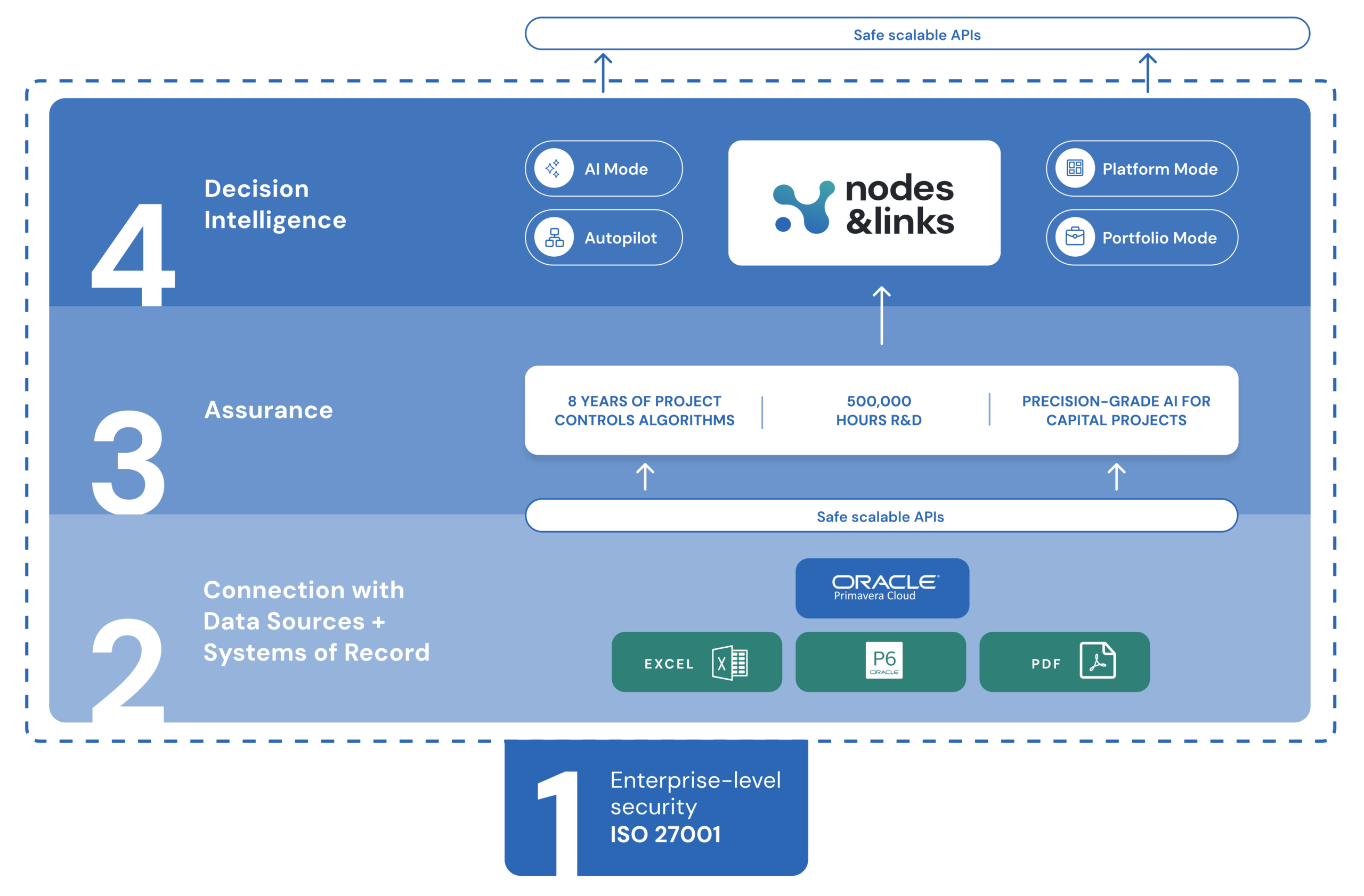
Before any of the features below existed, Nodes & Links spent eight years building the logic they all depend on: schedule integrity checks, change history, delay attribution, and risk models, connected securely to the systems of record that already hold project data. Every answer is grounded in fully auditable models compatible with P6 principles.
That foundation is what decides what good data looks like, flags when a submission deviates, and makes every answer traceable back to a method anyone can audit. AI Mode, Autopilot, Platform Mode, and Portfolio Mode all sit on top of it. Experts get depth, leaders get answers, teams get continuous monitoring, and everyone gets intelligence they can use to make a decision and defend it.
The AI features that turn schedule data into decisions
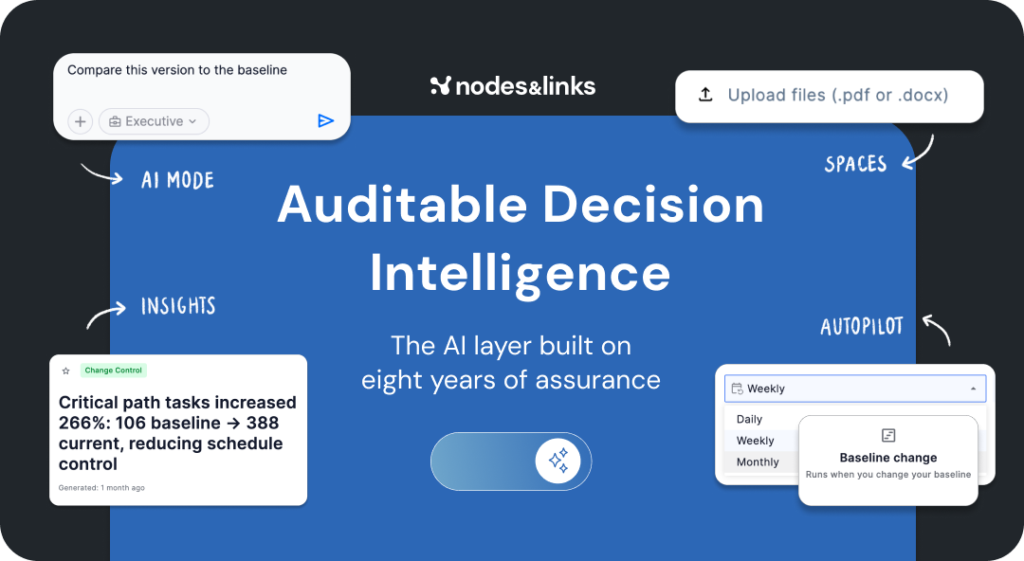
AI Mode is a chat interface built on that foundation, but the most significant thing it does is surface what the schedule is actually telling you before signals become problems.
Ask it about a submission and it identifies where float is eroding, where critical path logic is fragmenting, where change is compounding into delay, and where earned value trends are diverging from the baseline. It reads across the full schedule, not just the headline dates, and flags the conditions experienced planners know to look for: near-critical activities absorbing contingency, contractor sequences drifting out of alignment, delay patterns starting to compound. It does not just diagnose. It provides mitigation options grounded in the schedule data, so teams can evaluate recovery scenarios rather than simply absorbing bad news.
That is the layer of the platform that changes outcomes rather than reports on them. A planner who knows the schedule well can catch these signals manually, given time. AI Mode catches them across every upload, on every project, and surfaces them in plain language a project director or client-facing team member can act on without interpreting a schedule themselves.
Beyond schedule signal analysis, AI Mode handles the downstream work that follows. Ask it why the project is late, what to tell the client, or what to focus on in tomorrow’s huddle, and it shows its reasoning as it works through the answer. Ask it to draft the contractor update once it has the facts, and it will, in the tone the moment calls for, still anchored in the same evidence.
Insights removes the guesswork about what to ask. Every schedule upload triggers a sweep that surfaces 50 ranked findings across risk, delay, critical path, progress, and health, before anyone opens a screen. Each finding opens into a pre-seeded AI Mode conversation, so the question is already framed. Share it to the team board and the whole project sees it instantly.
Spaces lets you bring your own documents into the conversation: RFIs, change orders, progress trackers, email threads. AI Mode checks them against what the schedule actually shows, helping interpret and cross-reference uploaded material. Answers drawn from that material are clearly distinguished from verified schedule findings.
Autopilot: the check nobody has to remember to run
Autopilot runs the same underlying checks without waiting to be asked. Set the question once, a weekly slip report or a critical path check on every new upload, and Autopilot delivers the answer to the right inbox automatically. The assurance is identical to what AI Mode produces; the difference is the trigger.
Why this is decision intelligence, not a chatbot
AI Mode and Autopilot give teams two different ways to reach the same foundation. One answers when asked. The other runs without being asked. Both draw on the same schedule integrity checks, change history, and risk models built over eight years, not generated fresh by a language model guessing at project management.
That is what auditable means in practice. It means that when someone asks how a delay position was reached, or why a claim was scoped a certain way, there is a trail back to real project controls logic behind the answer, not a black box.
Systems of record store the data. Nodes & Links is what turns that data into a decision someone can defend, in a client meeting, a board review, or a dispute. AI Mode and Autopilot are how that decision reaches people. The assurance underneath them is what makes it trustworthy.