
Every year, the construction and infrastructure industry publishes a new set of reports. The numbers change slightly. The conclusions do not.
Projects overrun, disputes escalate, and careers take the hit. The people at the centre of it, the schedulers, the controls engineers, the PMO leads, carry more complexity, more pressure and more accountability than any system was ever designed to support. They are among the most technically capable professionals in any industry, working with sophisticated tools and decades of methodology, and still the weight falls on the same shoulders.
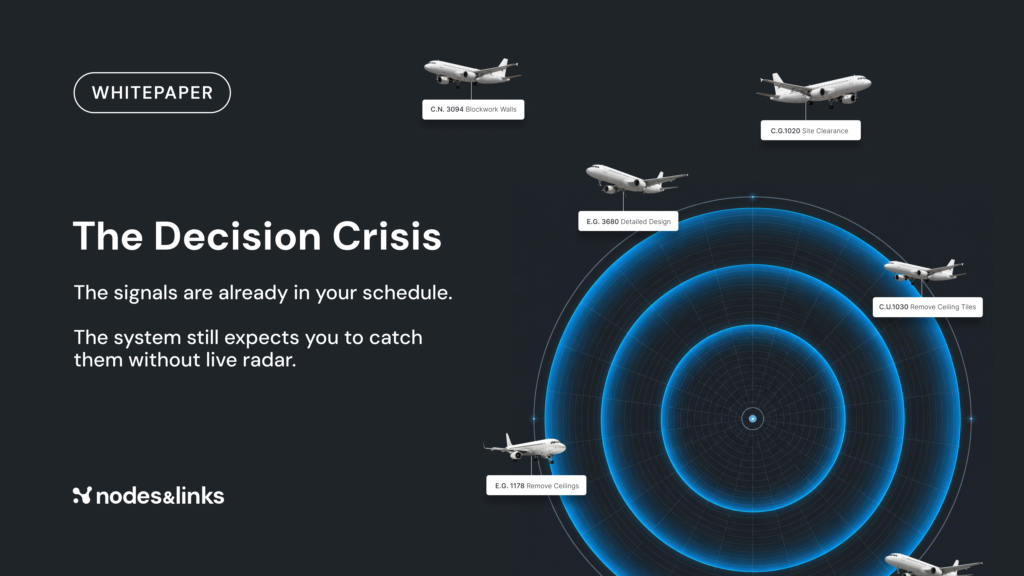
This whitepaper argues that the problem has a name. The decision crisis is not a failure of people, but of the system built around them: a system that has never been designed to give them the information they need, at the moments they need it, to make better decisions in time. It is not a workforce problem or a data problem. It is a systemic unfairness, and for the first time there is a solution designed specifically to address it.
Inside the whitepaper:
- The crisis nobody named
Defines the decision crisis as the gap between abundant project data and late, painful decisions, and shows how that gap has quietly become a permanent feature of major projects. Sets up the central unfairness: outcomes are personalised, while the causes are systemic.
- Why the signal never forms
Shows how schedule, progress and risk data are collected, but rarely assembled into decision‑grade signals. Unpacks the hidden phase where risk is already building, yet nothing appears in reports, leaving teams exposed to questions about “why you did not see this” when the signal never really existed.
- The cost of late decisions
Traces how small variances and changes harden into locked‑in delay, overrun and loss of confidence by the time they surface formally. Connects these outcomes to the missing intelligence layer, rather than to individual effort, and quantifies how much is decided after options have already narrowed.
- The pressure on the people carrying it
Examines what it means for project controls professionals, PMO leads and directors to be accountable for decisions they are asked to make with partial, late or conflicting information. Describes the emotional and professional unfairness of being seen as “the problem” when the role is operating beyond what current systems were ever designed to support.
- What decision intelligence changes
Introduces decision intelligence as the missing layer between raw data and action. Shows how AI can surface weak signals earlier, test scenarios and propose options so that responsibility is shared between people and systems, rather than resting entirely on individual judgement under pressure.
- What better looks like
Paints a picture of project controls and PMO work that is still accountable, but no longer unfairly loaded. Describes practical shifts from reporting outcomes to shaping them, from isolated schedules to portfolio‑aware decisions, and from individuals absorbing blame to systems that finally have their back.