

Nodes & Links introduces Autopilot, a new feature that automatically monitors your project and delivers schedule intelligence directly to your team’s inbox the moment it matters. No manual checks, no review cycles. Just the right insight, to the right people, at the right time.
On major infrastructure and capital projects, the decisions that matter most are also the ones with the narrowest window to act on. Whether a delay gets recovered or compounds, whether a risk gets mitigated or becomes a dispute, whether a claim gets prevented or turns into a protracted negotiation, these outcomes are rarely determined by a single catastrophic failure. They are determined by dozens of smaller decisions made under pressure, often without the full picture, by people who were already stretched thin before the issue even surfaced.
The problem, almost universally, is not that the right expertise isn’t on the project. It is that the right information doesn’t reach the right people in time for that expertise to make a difference.
Why Schedule Intelligence Has Always Been Reactive
For decades, project controls has operated on a structural limitation that the industry has largely learned to accept: someone has to go looking for the information before anything can be done about it. A schedule gets uploaded, a reviewer opens it, analysis gets produced and distributed, and by the time that cycle completes, days or weeks have passed. The insight arrives after the window to act on it has already closed.
This isn’t a failure of process or people. It is simply the reality of working with the volume and complexity of data generated on a major project. No team, however experienced, can monitor every schedule update, every logic change, every risk trigger, continuously and at scale. Until now.
Introducing Autopilot
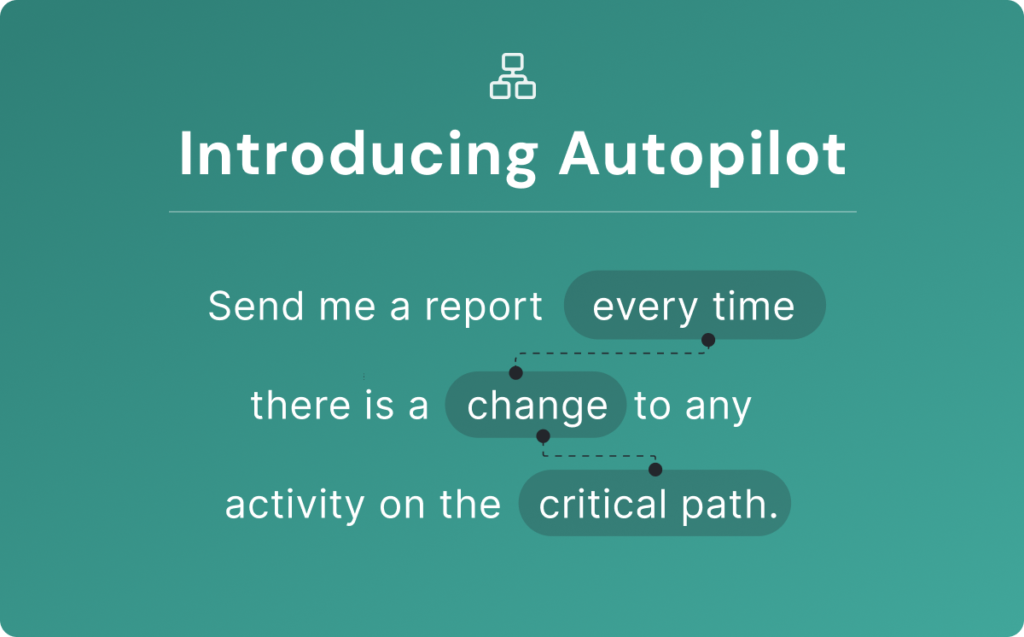
Nodes & Links Autopilot is the first feature built to put schedule decision intelligence on automatic. You tell Autopilot what matters: a new schedule version uploaded, an integrity score below threshold, a baseline change, a QSRA run completed. The moment that trigger fires, Autopilot runs your question against live schedule data and delivers the answer directly to every stakeholder who needs it, without anyone having to ask.
The result is schedule intelligence that arrives when it can still change the outcome, not after the fact.
What That Looks Like in Practice
When a contractor submits a new schedule with a 3-day slip on a critical activity, Autopilot catches it the moment the file lands, flags the impact, and recommends how to recover it, all before the submission is accepted. The reviewer walks in already informed, and the decision gets made with full context while there is still time to act on it.
When a new QSRA run completes overnight, the risk manager doesn’t discover it on Monday morning. They wake up to a summary in their inbox, and the client briefing that afternoon is based on current numbers rather than last month’s. When a contractor quietly restructures activity sequences between submissions, Autopilot runs a baseline diff automatically on every upload and surfaces the deviation before it becomes the new normal.
This is what it means to never miss a claim, a delay, an opportunity, or a change.
Only Possible Because of What’s Underneath
Autopilot is not a notification system, and that distinction matters. The intelligence it delivers is grounded in a decade of project controls models, logic validation frameworks, and schedule analytics that Nodes & Links has spent years building and refining. When Autopilot identifies negative float on the path to a critical milestone, it is not simply reading a field in a file. It is interpreting the schedule the way a senior expert would and delivering that same quality of insight, in seconds, at scale across every project in your portfolio.
That foundation is what makes the outcome possible. Not just faster information, but genuinely better decisions.
The Outcome Is Project Assurance
The goal of Autopilot is not efficiency for its own sake. It is assurance. Your senior people already have the expertise to make the right calls. What they have always been missing is the right information arriving at the right time, with enough context to act on it confidently. Autopilot closes that gap, freeing your best people from the work of finding the signal so they can focus entirely on what only they can do: act on it.
When decisions get made on time and with full context, projects get assured. Delays get recovered, claims get prevented, and risks get resolved before they become problems. That is what a well-controlled project looks like, and it is now on Autopilot.
Put your schedule decision intelligence on Autopilot.
Want to see this live on your project today?
Talk to our team here.