

Capital projects are run by experienced, capable people. When so few land on time and on budget, the cause is rarely effort or expertise. It sits in the system that informs their decisions.
An RFI is logged in one system, a change order in another. Updates are keyed in, exported, reconciled, drafted, reviewed and rewritten. By the time a decision is made, it is often weeks after the data that should have prompted it, and every call still has to stand up in front of leadership, the client and sometimes a tribunal.
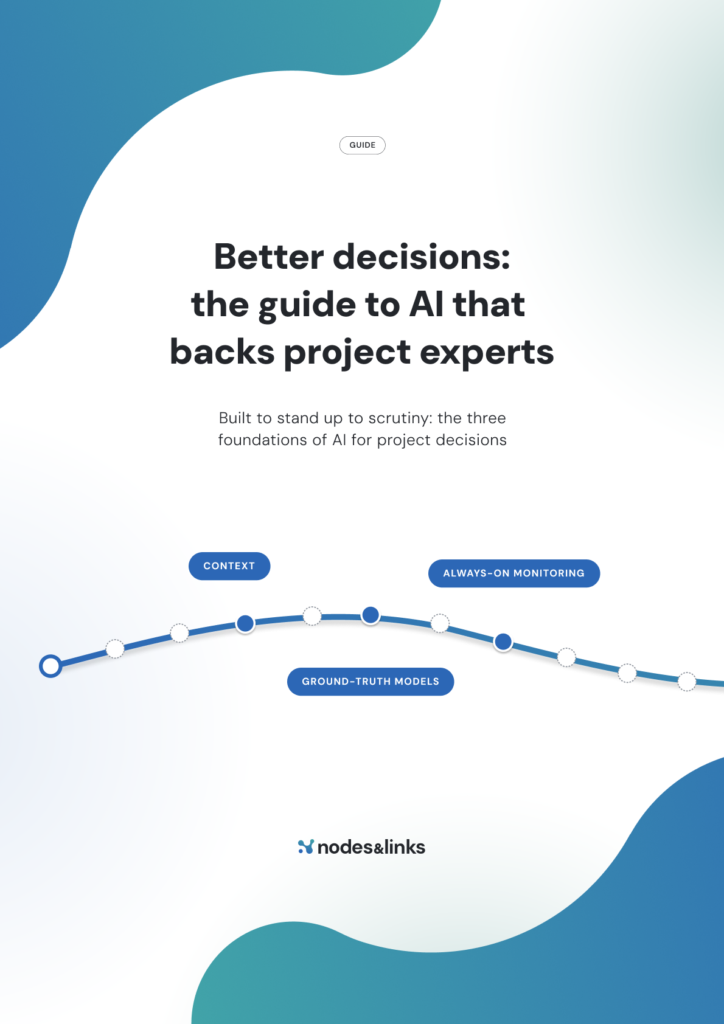
This guide shows how AI can change that while the expert stays firmly in charge. It explains what AI needs to support decisions you can defend, shows how it works on a live program, and gives you the questions to ask on your own projects.
Contents
Inside the guide
01
Every decision has to stand up to scrutiny.
Why decisions slow down on major projects, and why the answer is a better system rather than looser accountability.
02
The three foundations.
What it takes to redesign the system that informs project decisions, so information is complete, trustworthy and on time.
03
All your context, in one place.
Why the schedule alone rarely explains why a date moves, and the RFIs, change orders and documents that change AI answers most.
04
Ground-truth models you can trust.
How proven project controls models turn AI answers into ones you can trace and defend.
05
Always-on monitoring.
How leading indicators flag where a project is likely to slip, while it is still cheap to fix.
06
In practice: seeing the delay before it lands.
How ECS surfaced up to 10 days of completion delay and $4.5M of exposure on a major iron ore plant upgrade.
07
Seven questions that get better with context.
Prompts for delay recovery, change, claims, risk, acceleration, compliance and progress.
Sound familiar?
The data was there. The decision came too late.
0.5%
By the numbers
of major projects finish on time and on budget
Of 16,000+ major projects, only 0.5% land on time, on budget and as promised. $1.6 trillion is lost every year to late and over-budget delivery.
Source: Flyvbjerg & Gardner, How Big Things Get Done (2023); McKinsey Global Institute
“Loosen accountability? Or redesign the system.”
Greg Lawton
CEO and Co-founder, Nodes & Links
What you’ll take away
- A clear framework. Three foundations you can use to judge any AI tool your team is considering, from context to models to monitoring.
- Proof from a live program. How ECS used Nodes & Links to find its biggest risk two months ahead, with the numbers to show for it.
- Questions to use this week. Seven prompts to take into your next project review, change meeting or board discussion.
Featured in the guide