01
A risk workshop’s inputs, in one click.
Our AI proposes three-point estimates for every activity from how similar completed work actually performed. Templates and manual entry are there whenever you want them.
AI QSRA
Use cases
By organization
Featured stories
Latest from the blog
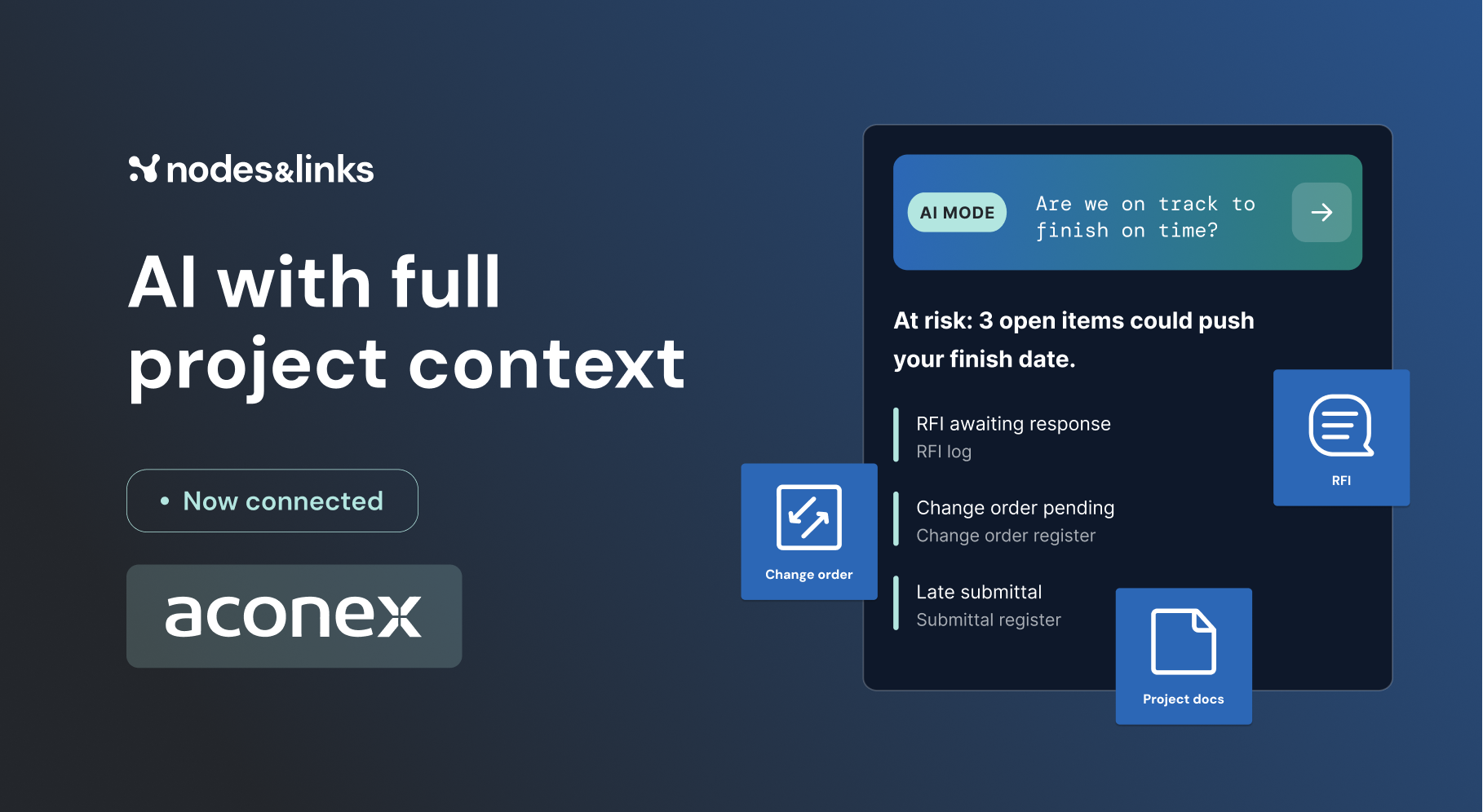
AI with full project context: Connect Nodes & Links with AconexNovember 5, 2026All blog posts →Featured guide
GuideThe Executive Guide to AI for Project DeliveryTest date confidence, understand project risk and focus interventions, with auditable evidence.Read the guide →All guides →Watch, read and learn
WebinarsLive sessions and on-demand replays.WhitepapersLong reads on where project delivery is going.ResearchThe peer-reviewed work behind the models.Platform coursesShort videos on getting more from the platform.The Physics of Project AccelerationOur book on pulling project dates forward.All resources →Platform / Ground truth models / QSRA

QSRA software
Monte Carlo QSRA with AI-assigned duration uncertainty, a full risk register, pre and post mitigation and risk drivers, all on your live schedule.
Why teams choose it
Our AI proposes three-point estimates for every activity from how similar completed work actually performed. Templates and manual entry are there whenever you want them.
Industry-standard Monte Carlo that respects every calendar, constraint, lag and lead, and is continuously tested for accuracy.
Risk drivers rank every activity and risk event, and pre and post mitigation runs show exactly what each action buys you.
Technical specification
Duration uncertainty
Apply your templates, enter values by hand, or let the AI recommend minimum, most likely and maximum durations from how similar completed activities actually performed. Every AI value can be reviewed and overridden.
Risk register
Define each risk event with a probability and an impact distribution, mark it as a threat or an opportunity (opportunities show as left-pointing bars in the tornado), set how often it can recur, and choose whether it hits every assigned activity the same way.
Mitigation
Add mitigated probability and impact for any risk event. One run produces both scenarios on the same chart, with P50, P80 and P95 side by side.
Risk drivers
For any activity and any P-position, see the top 20 drivers, split into duration uncertainty and risk events. Switch between percentages, days and raw correlation, and compare with your previous update or your mitigation scenario.
In days: a 37.5% driver on a 200-day P80 delay is 75 days.
Modeling fidelity
Results are only as good as the logic underneath. Every calendar, constraint, lag and lead is honored, so the risk profile reflects the schedule your team actually built.
Workflow
Work in days, hours or minutes, switch between WBS and activity codes, carry your risk profile forward from the last update, and move inputs and results in and out of Excel.
Risk governance
Define your standard risk events once at workspace level, import them from Excel, and apply them to any project. Each event shows exactly which projects it’s applied to, so risk governance is visible across the whole portfolio.
Monte Carlo simulation with completely random sampling. You set the number of iterations from 1 to 10,000, with 1,000 as the default.
BetaPERT, Triangle and Uniform for duration uncertainty. Risk event probability can be a single value or uniform, and impact can be a single value, uniform, triangle or BetaPERT.
It recommends minimum, most likely and maximum values for each activity based on how similar completed activities have actually performed. You can accept, adjust or override every value.
Every activity is modeled on its own business calendar, constraints are applied consistently with Primavera P6, and mandatory constraints are applied at the end of each iteration. Lags use the calendar defined in your schedule data.
Activities in a cycle are ordered by their scheduled start so the simulation can run, and the cycle is flagged so you can fix it.
Yes. Import duration uncertainty and risk assignments from Excel, and export them along with P5, P50, P80 and P95 results for every activity.