

If you’ve ever sat in a project review meeting, or an adjudication, and dreaded the question ‘How did you get this number?’ because the only answer you could give was ‘the algorithm said so’, you already know the unwritten rule of project controls; if you can’t defend it, you don’t own it.
In project controls, every float value has a source. Every delay claim stands or falls on whether the mathematics behind it can be proven. In fact, providing verifiable, defendable and auditable data is the foundation of how disputes get resolved, how claims get filed and how accountability gets assigned.
This is especially vital given HKA’s eighth annual CRUX Insight Report found that – across more than 2,200 projects in 114 countries – sums in dispute averaged 33% of contract budgets, and time extensions sought by contractors amounted to 65.8% of planned schedules.
For megaprojects with contract values over $1 billion, McKinsey’s analysis of more than 300 projects found average cost overruns of approximately 80% and schedule delays of around 50%.
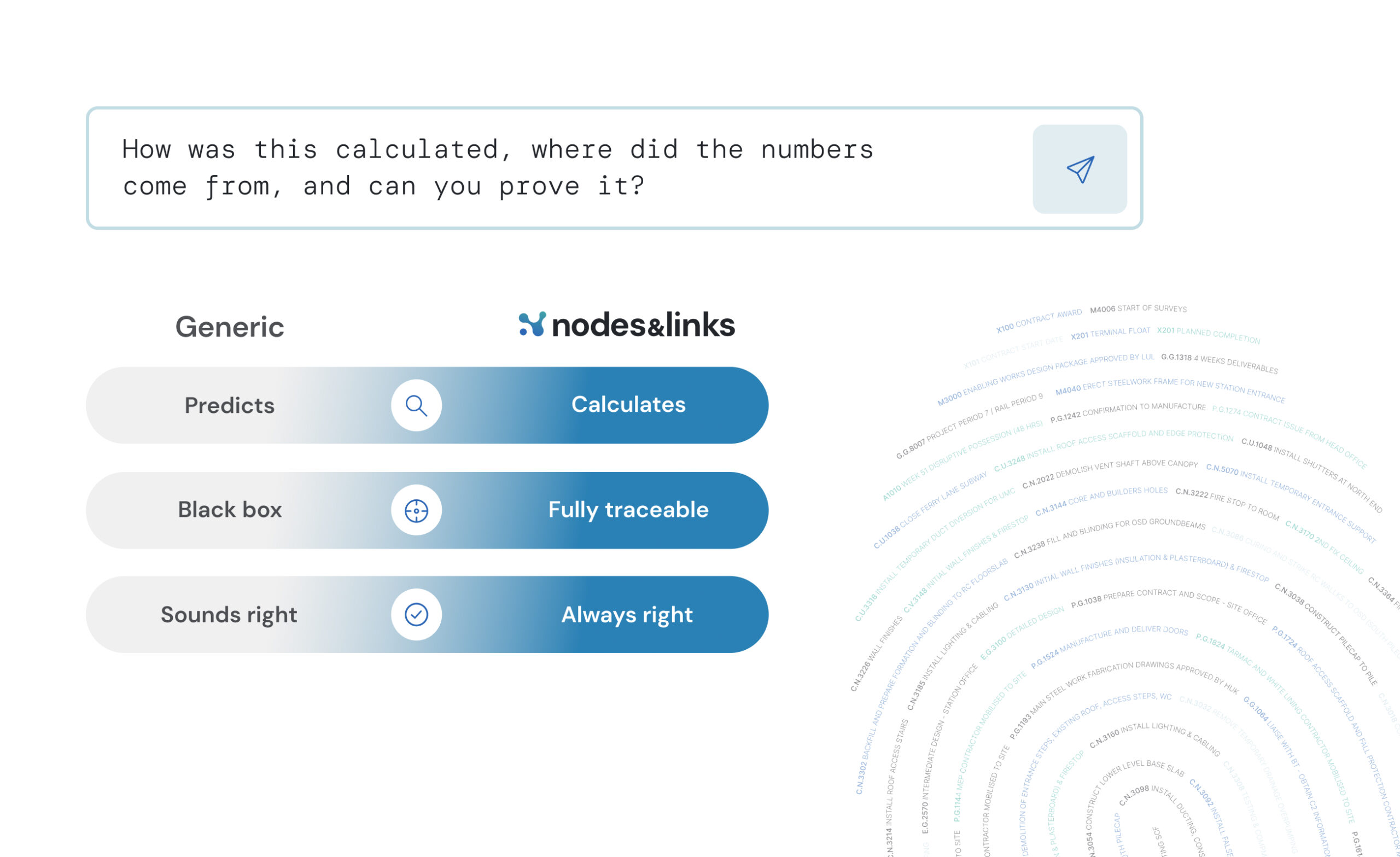
At that scale, schedule analysis is a legal and commercial function. When a dispute lands in adjudication, the questions are; ‘how was this calculated? Where did the numbers come from? Can you prove it?’
Most AI tools being used by project controls teams aren’t capable of answering these questions.
AI that predicts versus AI that calculates
A wave of AI tools has entered the project controls market in recent years. With the capabilities on offer genuinely impressive in some areas, the pressure to adopt is real. However, there is a distinction that is not always acknowledged by buyers and by many of the vendors entering this space; large language models don’t calculate, they predict.
An LLM will generate outputs by identifying the most statistically likely response based on its training data. When asked a numerical question, it doesn’t perform arithmetic. It produces characters that look like the right answer. The result is something commonly known as hallucination – outputs that are confidently presented but factionally incorrect, with no mechanism for the system to flag or recognise the error.
In a project controls environment, this is a significant legal risk. A scheduler who uses a generic AI tool to estimate float on a critical activity and makes a claim decision based on a plausible-sounding but wrong answer will have no defence in adjudication.
Likewise, a contractor who submits an AI-generated schedule narrative in an extension of time request, could then face an opposing counsel asking for the calculation methodology, with only a prediction to offer. Predictions aren’t evidence.
As a result, AI has a clear role in project controls. The important question is, which kind?
Defining auditability
While auditable is a word loosely used across the technology sector, it has a precise and demanding meaning in project controls.
Ultimately, an auditable output is one where every number, value and conclusion can be traced to its source data – the specific schedule activities, relationships, constraints and durations from which it was derived. It is entirely reproducible; if the same input data is provided, the same output will be produced every time.
Grounded in established CPM principles, the methodology is known, documented and recognised. Furthermore, all numerical outputs depend on the logic embedded in the schedule and the mathematics applied to it, not on a model’s learned associations or statistical weights.
Courts have been very explicit. Schedule delay analysis must be grounded in documented methodology, applied to actual project data, by an expert who can explain every step. AI-generated analysis from a current general-purpose LLM that cannot be decomposed intro traceable calculations will fail that test entirely.
Our CEO, Greg Lawton, has seen this play out directly with customers. On a recent Sustainability Talks podcast, he referenced a conversation with a team delivering critical infrastructure. While they were keen to take advantage of the productivity and intelligence advantages, they had no tolerance for errors and refused to move to AI unless someone could prove it was answering correctly.
Having wanted a significant level of auditability since general LLMs came online but with no solution previously available, they were incredibly relieved when they found Nodes & Links.
AI interprets. Mathematics calculates
Nodes & Links is built on a different architecture to generic LLMs. While it uses AI extensively, it is only for interpretation and communication.
The AI performs three functions. It interprets schedule data to surface patterns, anomalies and risks that would take human analysts significantly longer to identify, it communicates findings in natural language, making complex schedule analysis accessible to a wider range of stakeholders, and it guides users through workflows, filtering signals from noise.
Every calculation Nodes & Links performs is executed by purpose-built data science models grounded in eight years of CPM methodology and project controls expertise.
Every critical path identification, delay quantification and float value is fully traceable to the schedule data – and the methodology from which it was derived. There’s no ‘the AI said so’; it’s documented, reproducible and defensible mathematics.
This is crucial before disputes arise, not only during them. During a capital project, the costliest decisions are whether to accelerate, whether to issue a change order and how to sequence recovery work. These are all schedule-driven, meaning decisions made on the basis of unauditable AI outputs often carry embedded risk that remains invisible until it surfaces in a claim or a project overrun.
Ultimately, planners and schedulers remain in full control of decision-making. The platform operates at the task level, with project controls teams retaining the authority to direct it whenever needed.
Intelligence must align with auditability
In a project controls environment where accountability and auditability are paramount, the platforms that will remain successful will be those that apply AI intelligently, within an architecture that preserves mathematical rigour and guarantees auditability at every layer.
Gain a full insight into what auditable decision intelligence actually means by downloading our ‘The Only AI Platform That Doesn’t Trust AI’ whitepaper here.
To hear Nodes & Links CEO, Greg Lawton, discussing auditable AI, hallucination risks and the future of project controls in depth, listen to his full conversation on the Sustainability Talks podcast, Episode 40.